
July 7, 2026
Most conversational AI demos work. But very few conversational AI systems survive a live, unscripted phone call where the IVR menu is unfamiliar, the hold music runs eight minutes, the human on the other end interrupts mid-sentence, and a single wrong word about insurance eligibility becomes a compliance problem. That gap between demo and deployment is exactly where AZcall is built to operate, and it's why we're diving into the architecture behind it.
If you’re interested in learning more about AZcall, this is the layer beneath the product story: how we engineered for AI voice agent reliability, what the internal benchmarks show, and why we think this approach holds up as we scale across telecom, UCC, and healthcare workflows.
The Problem with Monolithic AI Prompting for Voice Agents
Most voice AI products still run on a single, massive system prompt: one instruction set trying to hold user identity, conversation history, compliance rules, tool definitions, and edge-case handling all at once. That approach works fine in a demo, yet it degrades quickly in production; especially on the smaller, faster models required to hit real-time latency targets. The model starts blending instructions across conversation stages, misreads phone menus, or fabricates details it was never given. This is what we call instruction interference.
Our internal benchmark of 5,000 simulated care-coordination and scheduling test calls put a number on that failure mode: a monolithic-prompt baseline completed only 64.2% of tasks and hallucinated on 8.4% of turns, with response latency spiking past 1.4 seconds — well outside the range that feels like a natural conversation.
How AZcall's Multi-Agent AI Architecture Works
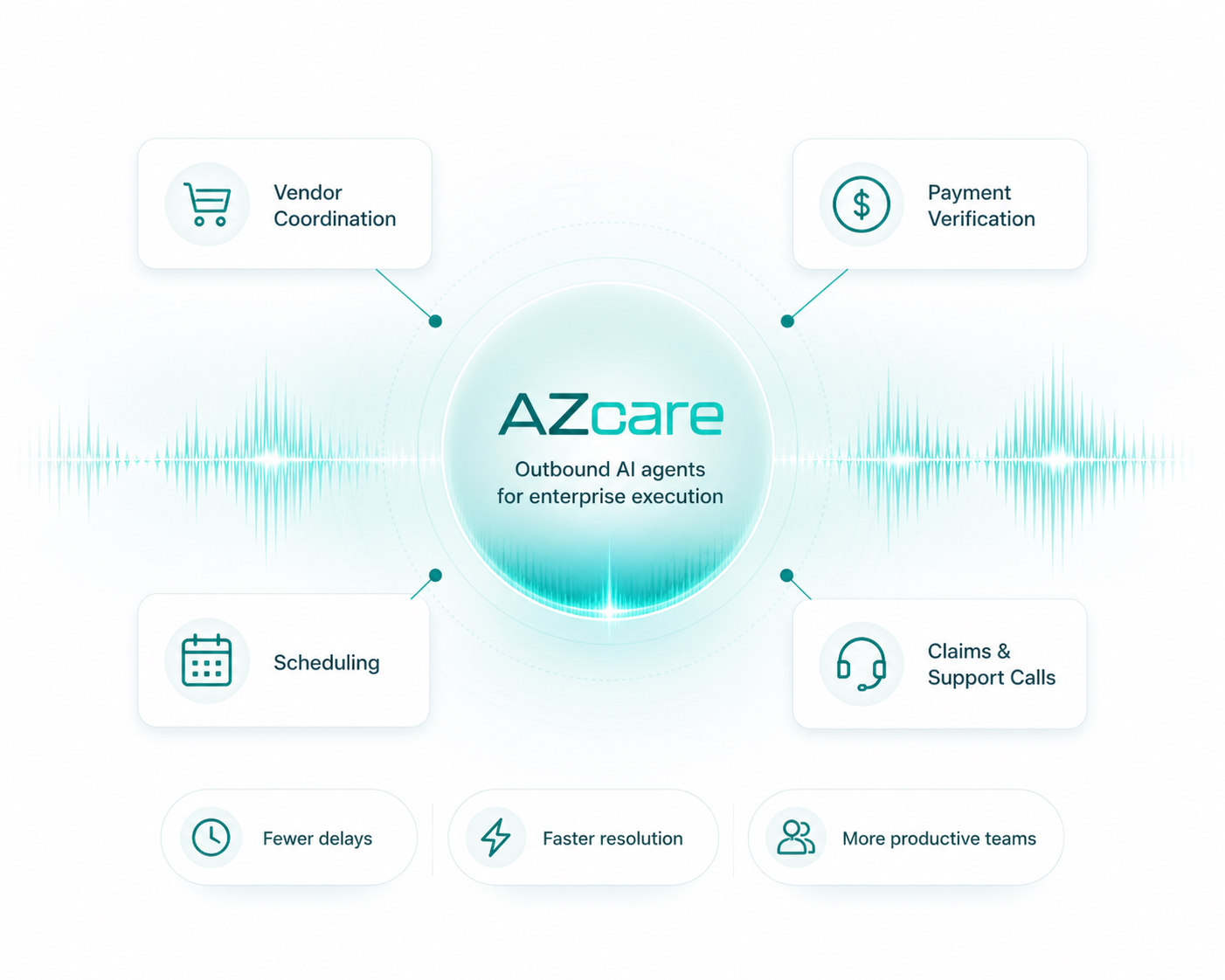
AZcall runs on what we call the Dynamic Language System, built on two complementary layers:
Real-Time Context Management (RT-CM)
Instead of one model juggling everything, RT-CM breaks the call into a swarm of narrow, single-purpose micro-agents. One handles calendar negotiation, one navigates IVR menus, one manages sensitive data retrieval, one drives call wrap-up, and so on. Each agent sees only the data and tools it actually needs for its job, running in parallel underneath a lightweight router. That isolation does three things at once: it shrinks the context each model has to reason over, it enforces hard data boundaries between call stages (insurance and billing fields, for example, stay locked away from the agent negotiating appointment times), and it takes latency down substantially.
Multi-Latency Supervisory System (MLSS)
Speed and deep verification pull in opposite directions. You can't run heavyweight compliance reasoning on every single turn without breaking the conversation. MLSS resolves that by running three supervisory tiers in parallel: an ultra-low-latency layer driving the live conversation, a mid-latency layer watching the full call transcript in real time and correcting errors on the next turn, and a post-call audit layer that verifies every completed task against the actual transcript before anything gets written to the database. Nothing gets marked 'done' just because the model said so - it has to be independently confirmed in what was actually said on the call.
AI Voice Agent Benchmark Results: Task Completion, Hallucination Rate, and Latency
We ran the same 5,000 test call benchmark across three configurations: a monolithic baseline, RT-CM alone, and the full RT-CM plus MLSS stack that powers AZcall today.
Layering in full supervision adds roughly 100 milliseconds of latency over RT-CM alone; still well inside the 900ms upper bound needed for a call to feel natural, while pushing task completion to 98.4% and hallucinations down to 0.2%.
That's the number that matters most for anyone deploying this into regulated healthcare or high-volume enterprise call flows: the system is not just fast, it's verifiably accurate.
AI Voice Agents for Telecom and UCC: Why Infrastructure Fit Matters
AZcall isn't a robocaller or chatbot with a phone number attached, it's built with real telephony infrastructure in mind. The architecture accounts for PSTN and SIP trunking behavior, streaming ASR under real network conditions (packet loss, interruptions, background noise), and low-latency neural TTS, because those are the actual constraints of a live call, not a text-based simulation of one.
For UCC and telecom partners specifically, this translates into a system that plugs into existing call infrastructure without asking a carrier or platform to change how calls are routed or metered. The intelligence sits in the agent layer, not in a replacement of the telephony stack.
AI Agent Cost Economics: Why a Multi-Model Architecture Doesn't Increase Spend
A fair diligence question on any multi-model, multi-layer AI system is cost: doesn't running several models per call multiply spend? In practice, no. Telephony cost (SIP trunking minutes, streaming ASR, and real-time TTS) runs roughly two orders of magnitude higher per minute than the token cost of the language models coordinating the call. The added LLM spend from running parallel micro-agents and supervision is a rounding error next to what's saved by cutting call handle time, eliminating repetition loops, and avoiding the manual remediation that failed automated calls otherwise require.
The Future of Reliable AI Voice Agents
Today, AZcall's micro-agent boundaries and handoff logic are engineered and configured directly. The next phase of this research is Autonomous Context Partitioning – a system that learns optimal agent boundaries and handoff points directly from call logs and supervisor intervention data, reducing the manual configuration needed to extend AZcall into new workflows and verticals. Longer term, we're tracking what it would take to build multi-latency reasoning directly into a single model, rather than coordinating it across separate calls. Both directions point at the same goal: making reliable, real-time voice AI cheaper to extend and harder for competitors relying on single-prompt architectures to replicate.
Schedule a Technical Briefing on AZcall
This post covers the architecture at a level meant for technical and investment diligence. If you're evaluating AZcall for a UCC, telecom, or enterprise integration and want a deeper technical briefing, including a live walkthrough of the benchmark methodology, please reach out and we will be happy to schedule time.
For more information, please contact AZcare.