
July 21, 2026
Two of the most cited AI failures in the enterprise world didn't happen because a company chose a bad vendor. They happened because the underlying architecture asked one probabilistic model to do a job it was never built for: managing deterministic business logic (orders, policies, refunds) with no hard rules underneath it. McDonald's and Air Canada are the two clearest public examples of what that costs, and they're worth understanding before you evaluate any AI voice vendor.
A Three-Year AI Pilot That Ended in Silence
In 2021, McDonald's partnered with IBM to automate order-taking at roughly 100 drive-thru locations using natural language AI. But by July 2024 the trial was over, and the chain went back to human headset operators. The reported reason: order accuracy had plateaued between 80% and 85%, well below the 90%-plus accuracy human operators typically sustain — a gap that adds up fast in wasted food, slower lines, and frustrated customers.
The failures weren't subtle. Documented incidents included an order for nine sweet teas nobody asked for, bacon and butter added to an ice cream sundae, and a $222 order for 260 chicken nuggets from a customer who requested none of it. The common thread in each case: a noisy, uncertain audio signal. Things like engine sound, wind, even a nearby car's order being placed got the AI model guessing at what the statistically likely next word would be instead of stopping to ask for clarification.
McDonald's hasn't abandoned voice AI; the fast-food chain is now testing a second-generation system, ArchIQ, built with Google. Early reporting cites a 90% completion rate without human takeover. But completion isn't the same as accuracy: an order that gets fully processed without a human stepping in can still contain the wrong item all the way to the point-of-sale system. That distinction between “did the call finish” versus “was the outcome correct” is exactly the kind of gap that matters to anyone deploying voice AI into a regulated or high-stakes workflow.
When an AI Chatbot Answer Becomes a Legal Commitment
The Air Canada case is the clearest example on record of a company being held liable for what its AI said. A customer asked the airline's website chatbot about bereavement fare policy. The chatbot answered confidently (and incorrectly) describing a retroactive discount process that didn't match the airline's actual policy. The customer relied on that answer, was later denied the discount, and took the matter to a civil tribunal.
Air Canada's defense was that the chatbot was effectively a separate entity, responsible for its own words. The tribunal rejected that argument outright: a business is responsible for everything published through its digital channels, including whatever an AI system generates in the moment. There's no legal shelter in "the bot said it, not us."
That ruling matters well beyond airlines. Any company putting an AI voice or chat agent in front of customers is on the hook for what that agent tells them, which means the actual question isn't whether your AI can talk convincingly, it's whether what it says is provably grounded in your real policies, in real time.
The Pattern Shows Up Everywhere Deterministic Guardrails Are Missing
McDonald's and Air Canada aren't isolated incidents, they're the two most public examples of a pattern that keeps repeating wherever a language model is trusted to handle business logic on its own, without a hard-coded layer checking its output. A European privacy group filed a GDPR complaint after a chatbot fabricated a detailed, false criminal history for a real person, complete with an invented prison sentence – the model had woven in accurate personal details, which made the fabrication more convincing, not less. A consulting firm had to refund part of a government contract after a delivered report turned out to contain fabricated citations and invented academic papers. In each case, the failure traces back to the same root cause: a probabilistic model generating plausible-sounding output with nothing underneath it to check that output against ground truth before reaching a real person or a real decision.
The Fix Isn't 'Better Prompting'
It's tempting to read these as one-off mistakes that better instructions could have prevented. They weren't. Each case involved a system architecture where a single model was responsible for interpreting input, reasoning about intent, and generating output, with no independent layer verifying that output against real data before it reached the customer. No amount of prompt engineering fixes that. The fix is structural: separating the part of the system that interprets messy human language from the part that enforces business rules, checks facts, and controls what can and can't be said or committed to.
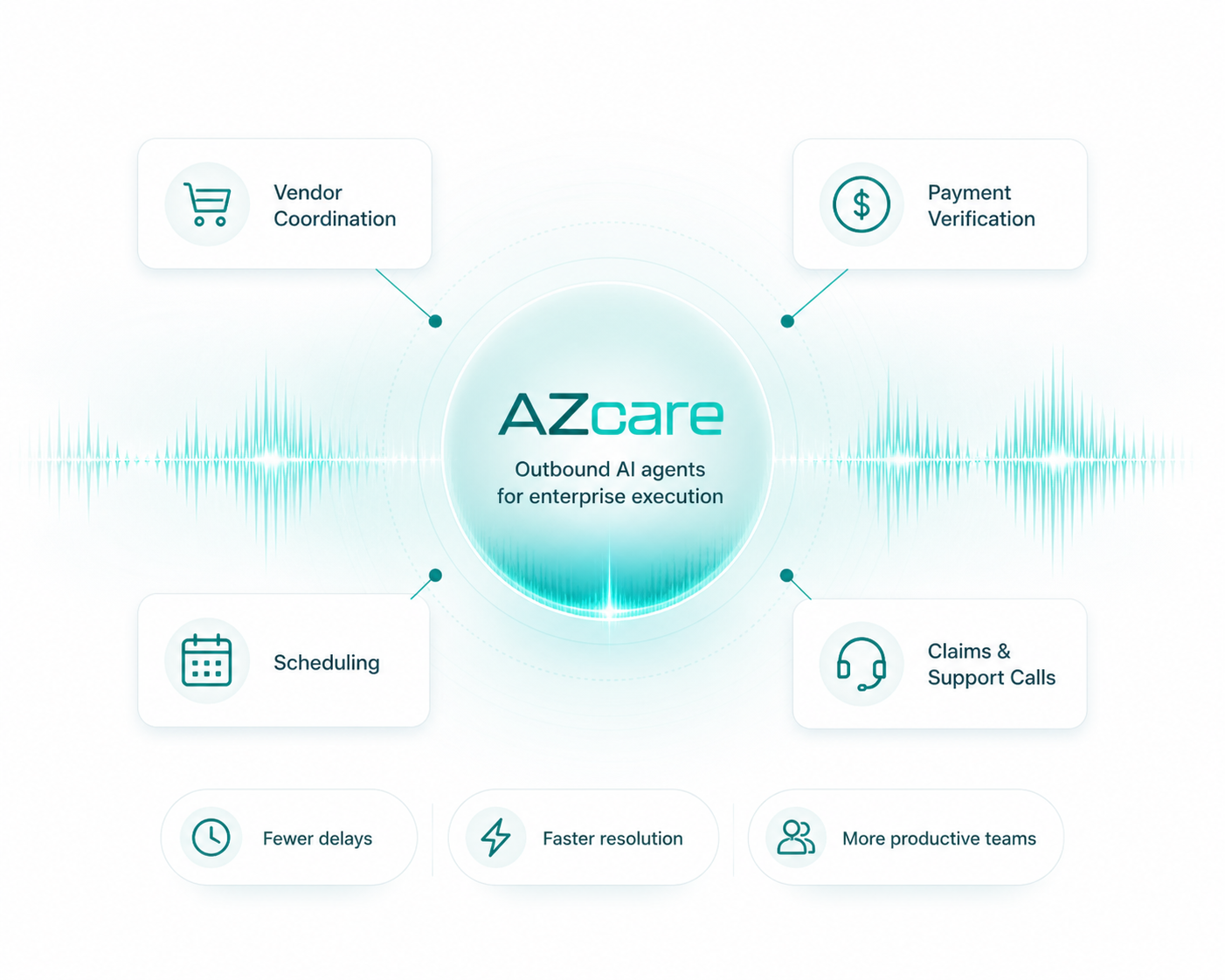
That's the architectural principle behind how we built AZcall; how the failure patterns above actually show up inside a live voice pipeline, and the specific deterministic guardrails that prevent them.
Talk to Us
If you're evaluating an AI voice vendor for a telecom, UCC, or enterprise workflow, the McDonald's and Air Canada cases are examples for having a reasonable diligence checklist. We're happy to walk through how AZcall answers that question directly and can help your business avoid these costly setbacks.
For more information, please contact AZcare.