
August 1, 2026

A live phone call is a much more complex problem than a text chat window, and most of the difference comes down to a handful of technical failure points that never show up in a demo recorded in a quiet room. Understanding where a voice pipeline actually breaks is the fastest way to tell a production-ready system from one that only works under ideal conditions.
The 500-Millisecond Rule
Human conversation runs on tight turns: the average silence between one person finishing and the other starting is roughly 200 milliseconds. Once an AI voice agent's response takes longer than about 500 milliseconds, callers start to perceive it as broken or unresponsive. On outbound calls, that perceived lag is often enough to end the call outright.
Staying under that threshold means controlling latency across four separate stages, each with its own delay budget.
First, network transport over the phone line typically adds 100 to 200 milliseconds before anything reaches the model.
Second, converting speech to text adds another 300 to 500 milliseconds or more, if the system waits for a complete phrase rather than streaming partial audio.
Third, the language model itself needs 400 to 800 milliseconds to produce its first word (especially if it's also executing a function call).
And fourth, turning that response back into natural-sounding speech adds a final 150 to 300 milliseconds.
Stack those up without careful engineering and total round-trip latency climbs to 1,000-1,800 milliseconds — well past the point where callers start talking over the system, assuming the line dropped.
Why Background Noise Can End Up in the Transcript
Standard microphones don't just capture the person talking, they capture everything in range. In a call center or any environment without directional audio filtering, a nearby voice, a passing car, or a running compressor can get folded into the same transcript as the caller's actual words. Low-frequency mechanical hums are a particular problem because they overlap with the frequency range of human vowel sounds, distorting the signal the speech-to-text engine is working from.

When the audio is unclear, it results in the failure mode that does the most damage. Modern speech-to-text engines are built to keep a transcript flowing even though there are gaps caused by wind, mumbling, or a dropped package – and they do that by predicting the most statistically likely missing words rather than leaving a gap. The result sounds fluent and plausible. It's also sometimes just outright wrong, and there's no obvious signal to a downstream system that it's looking at a guess rather than a transcription.
The Interruption Problem
Voice Activity Detection is the logic that decides when a human has started or stopped talking. It is a much harder tuning problem than it seems. Set it too sensitive, and background noise like a cough or even a hesitant "um" gets misread as the caller speaking – cutting the AI off mid-sentence and making it feel jumpy or aggressive. Set it too conservative, and it stops registering real interruptions, so when the AI is confidently reciting an incorrect policy or order and the caller tries to interrupt with "no, that's wrong," the system talks right over them. Both failure directions are common, and both directly damage trust in the system within a single call.
The Edge Cases Test Scripts Don't Cover
Production calls include a lot of behavior that a clean test script never exercises. For example, callers sometimes put the phone down to find a document and come back thirty seconds later. Without explicit handling, some systems respond to that silence by looping the same prompt every few seconds until the call times out. Callers also go off-script – bantering, asking unrelated questions, or deliberately probing the system's boundaries – and a system without clear guardrails for routing non-transactional input back to the task at hand can end up in an extended, unstructured conversation that consumes time, and in the worst case, can get manipulated into ignoring its own constraints.
There's also a quieter failure mode: context decay. Most conversational architectures hold up fine for the first few exchanges, but by the third or fourth turn, details the caller already provided (a name, a confirmed time, a selected option) start getting lost, and the system asks for them again. That's a small annoyance to a caller, yet a real reliability problem at scale.
Why This Matters for Telecom and UCC Evaluation
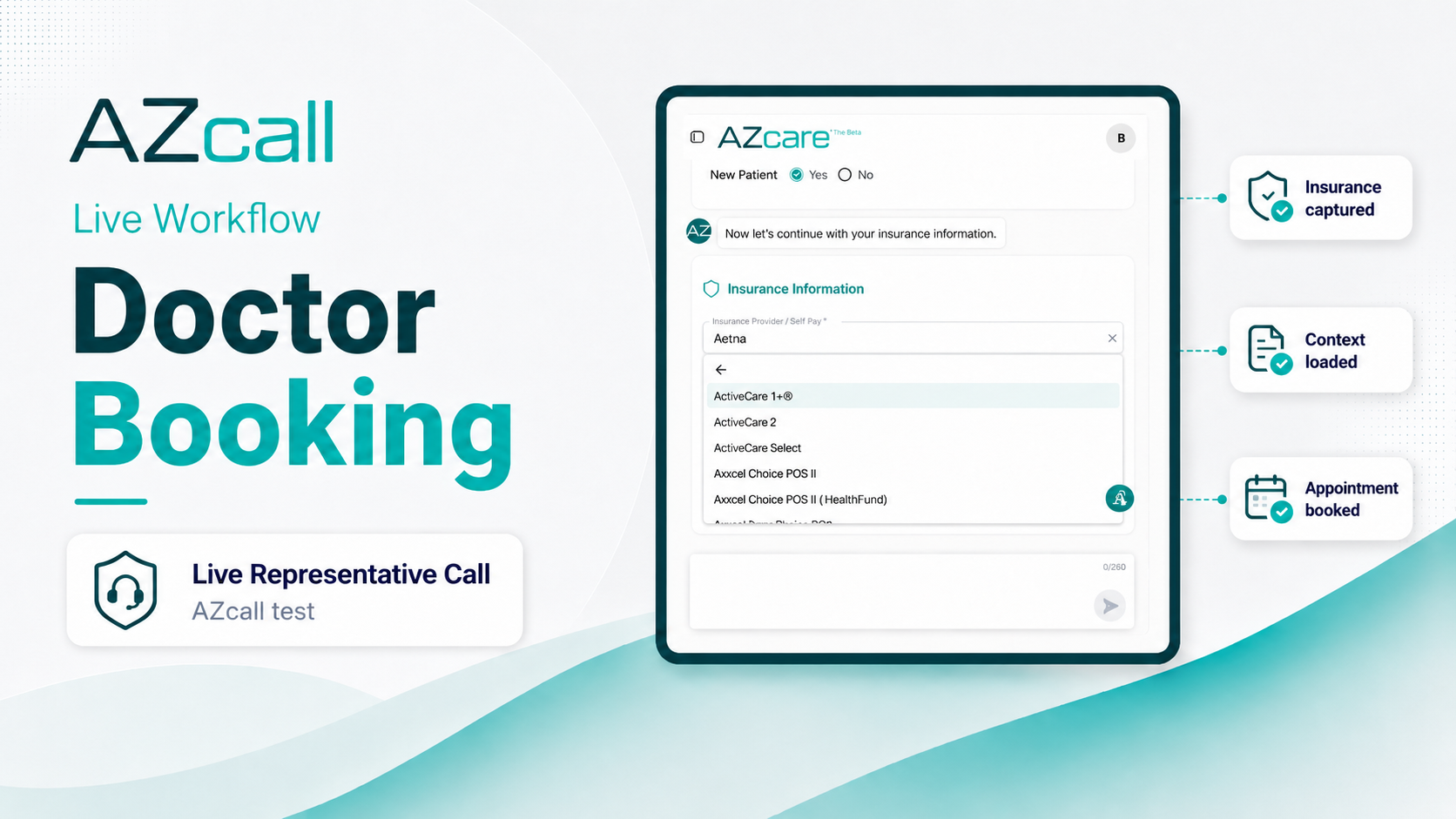
None of this is exotic. TTS is the standard operating environment for any system running over real PSTN or SIP infrastructure rather than a browser-based chat demo. When we talk about AZcall's P95 latency figures, this is the pipeline those numbers describe: a system engineered specifically for the acoustic and timing constraints of a live phone line, not adapted from a text-based chat architecture after the fact. If you're evaluating any AI voice vendor for a telecom or UCC integration, the questions above (how do you handle acoustic bleed, how is VAD tuned, what happens on a silent line, how do you prevent context loss past turn four) are the ones worth asking directly.
Talk to Us
We're glad to walk through how AZcall's architecture addresses each of these failure points specifically, including the benchmark data behind our latency and reliability numbers. Contact us to schedule a call or a demo.