
September 1, 2026
AI voice agents have moved rapidly from technology demonstrations into production environments. However, selecting a platform for enterprise deployment requires evaluating far more than conversational fluency.
A voice agent can sound remarkably human, and yet still fail at the fundamental task it was built to execute.
For enterprise technology, CX, and operations leaders, the core question is not “Does this sound natural?” but rather “Can this system reliably complete complex, real-world business workflows?”
Evaluating enterprise voice AI requires looking beyond voice quality to examine verifiable task completion, context retention, real-time adaptation, security, latency, and system integration. This guide provides the operational framework required to evaluate AI voice agents for enterprise use.
1. Workflow Mapping and Verifiable Task Completion
Before scheduling vendor demos, define the precise execution path of your target workflow. Evaluating an agent based on general conversational ability produces misleading results; enterprise evaluation must measure verifiable task completion.
Focus on the End State
Distinguish between conversation completion and task completion. An agent saying "I've updated your record" does not confirm that the underlying database or external system reflected that change.
Define the Full Path
A robust evaluation scope must explicitly identify:
The User Objective: The primary outcome requested by the caller or system.
Required Integrations: Systems, APIs, and databases the agent must query or update.
Failure & Escalation Rules: Precise conditions that trigger human intervention or alternative workflow paths.
2. Real-World Complexity and Unscripted Adaptation
Polished sales demos rely on predictable, linear paths. Production phone environments do not. Evaluating enterprise readiness requires stress-testing agents against the friction inherent in live human interactions.
Interruptions & Overlapping Speech: Test whether the agent halts gracefully when interrupted (barge-in) or continues speaking over the user.
Mid-Workflow Topic Shifts: Verify if the system can handle tangential questions and return to the primary task without dropping context.
Unexpected Inputs & Constraints: Test how the agent adapts when a caller provides unexpected data, declines a preferred option, or introduces new constraints.
Branching Logic: Assess whether the agent dynamically adjusts its decisions mid-call based on real-time responses rather than following rigid decision trees.
3. Context, State Management and Conversational Latency
Enterprise workflows frequently require callers to refine or alter their requests across multiple turns. A production-ready agent must maintain a persistent understanding of task state while keeping response latency low enough to maintain natural dialogue.
Context Retention and State Tracking
If a user states, "I need an appointment Tuesday," followed by, "Actually, Wednesday works better, but only after 3 PM," the system must process these inputs as constraints modifying a single, ongoing task state – not as three disconnected statements.
Operational Latency Metrics
Delays in voice interactions create immediate friction. Avoid evaluating latency based on average figures; request specific operational metrics:
Latency Metric Evaluation Focus
End-to-End Latency Total time from human utterance to AI audio response.
P95 / Peak Latency Response delay during maximum load or complex tool lookup.
Performance Under Load Latency impact when concurrent call volume spikes.
Note: Ultra-low latency is only valuable if the agent acts accurately. Never trade task accuracy for speed.
4. Enterprise Infrastructure, Security, and Control
An isolated voice agent cannot drive business value. The platform must integrate directly into existing telephony, contact center, and core enterprise software while adhering to compliance standards.
Infrastructure and System Compatibility
Telephony: Native support for SIP/PSTN trunking, existing call routing, and direct transfers to live agents.
Business Applications: Bidirectional API integration with CRMs, ticketing platforms, and scheduling engines.
Governance and Controlled Autonomy
Autonomous execution requires defined operational boundaries:
Role-Based Access Control: Strict permission limits on what data the agent can read or write.
Auditability: Complete logging of transcripts, latency, tool calls, and execution steps for compliance auditing.
Deterministic Escalation: Guardrails that force human handoff for high-risk or sensitive transactions.
5. Production Reliability and Scale Economics
A single successful call during a vendor demo proves technical possibility, not operational capability. AI systems can exhibit variable behavior across identical runs.
Repeated Execution Testing
Run representative workflows repeatedly to determine true operational reliability:
{Reliability Rate} = ({{Verifiably Completed Workflows}}{{Total Executed Calls}}) x 100
Evaluate success rates across at least 100 iterations per workflow to capture edge-case failures, regression issues, and system recovery capabilities.
Production Economics
Avoid evaluating ROI solely on automated call duration. Focus on cost per completed task:
{ROI Metric} = {{Tasks Successfully Completed}}{{Total Operational Cost (API + Telephony + Infra)}}
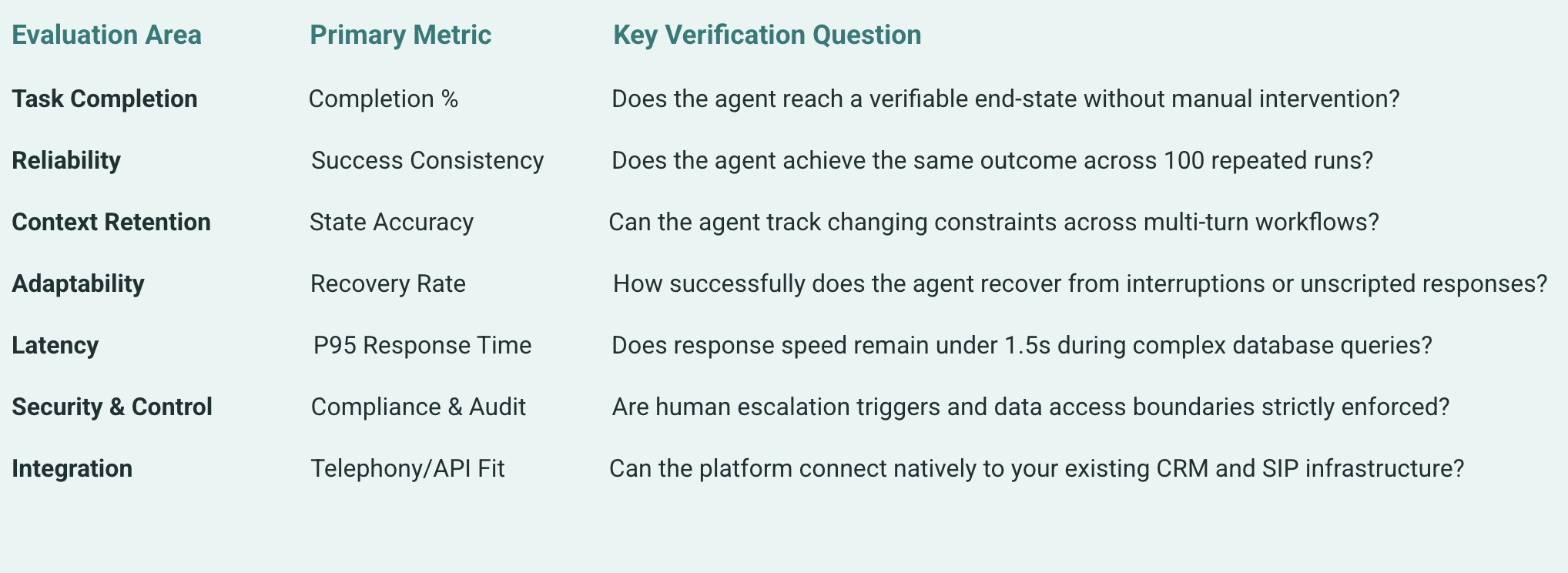
6. The Enterprise Evaluation Matrix
Use this matrix to score and compare voice AI vendors against production requirements:
7. The Workflow Proof Test and The AZcare Approach
Do not rely on pre-recorded vendor demos. Provide each prospective vendor with a single, complex workflow representative of your actual operations.
Include an interruption, an unexpected caller response, a constraint change mid-call, and a system delay. Score each platform on how effectively it navigates those real-world variables.
The standard for enterprise voice AI is moving beyond conversational fluency. The best AI voice agent isn't the one with the most impressive demo; it's the one that reliably completes the task when the demo ends.
How AZcare Approaches Voice Reliability
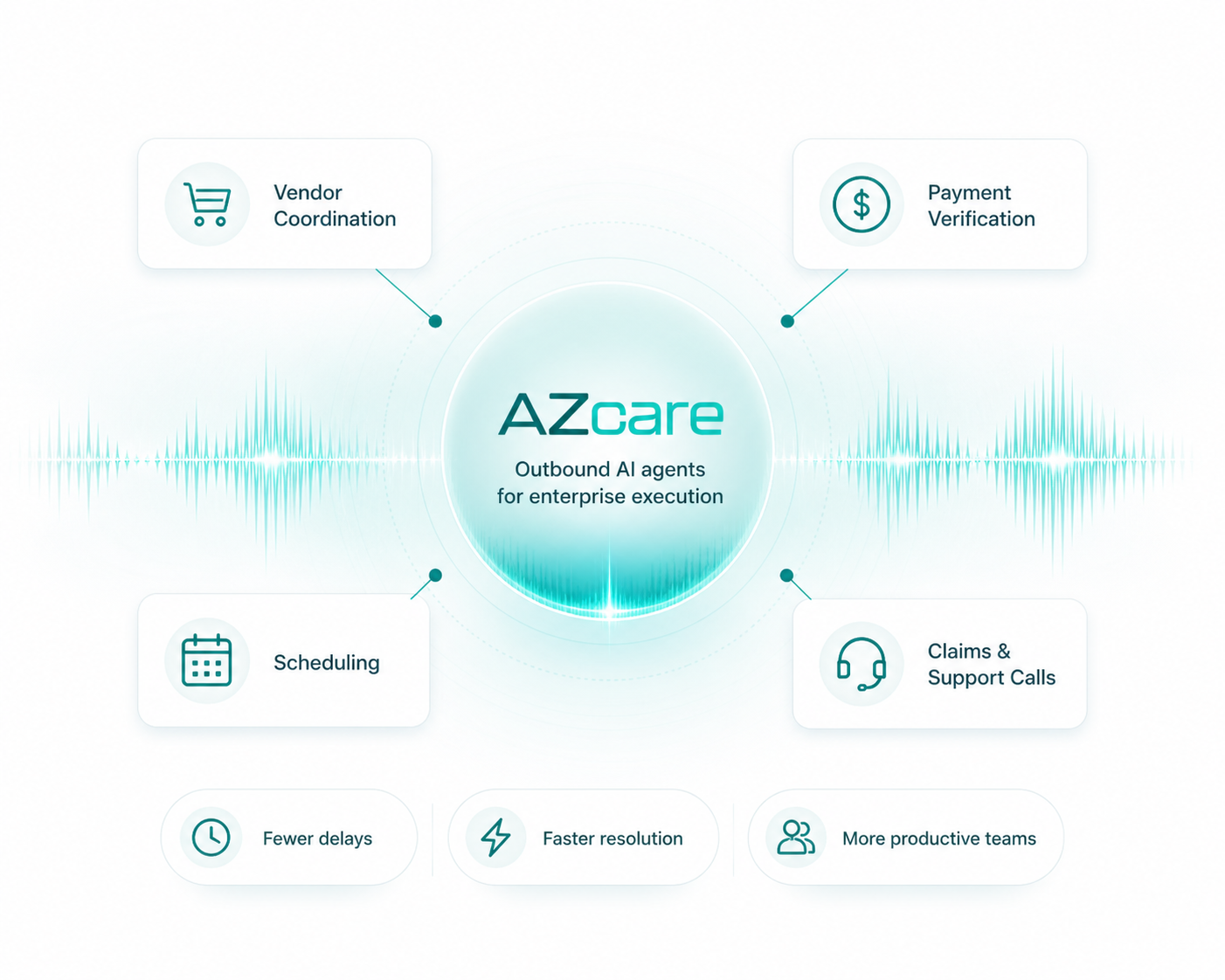
At AZcare, we believe execution is the product. AZcall is engineered specifically for dynamic, unscripted phone workflows where execution paths are unpredictable.
Powered by our proprietary Dynamic Language System (DLS), AZcare coordinates specialized AI capabilities across intent recognition, context management, and workflow execution in real time – enabling voice agents to adapt to complex conversations while consistently driving toward the intended business outcome.
Ready to evaluate AI voice for your enterprise?
See how AZcall handles complex, real-world workflows.